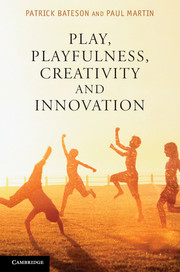
Play, playfulness, creativity and innovation / Patrick Bateson and Paul Martin.
Material type: TextPublisher: Cambridge ; New York : Cambridge University Press, 2013Description: xi, 153 pages : illustration ; 23 cmContent type:
 - text
- unmediated
- volume
- 1107015138 (hardback)
- 9781107015135 (hardback)
- 1107689341 (paperback)
- 9781107689343 (paperback)
- BF 717 .B28 2013
| Item type | Current library | Call number | Status | Barcode | |
|---|---|---|---|---|---|
 Book
Book
|
Storms Research Center Main Collection | BF 717 .B28 2013 (Browse shelf(Opens below)) | Available | 98646428 |
Browsing Storms Research Center shelves,Shelving location: Main Collection Close shelf browser (Hides shelf browser)
| BF 713 .S525 1952 The developing mind : how relationships and the brain interact to shape who we are / | BF 713.T485 2001 Recent theories of human development / | BF 713 .W33 2000 Necessary but not sufficient : the respective roles of single and multiple influences on individual development / | BF 717 .B28 2013 Play, playfulness, creativity and innovation / | BF 717 .B76 2010 Play : how it shapes the brain, opens the imagination, and invigorates the soul / | BF 717 .S5145 2005 Imagination and play in the electronic age / | BF 719 .K53 1985 The amazing newborn / |
Includes bibliographical references (pages 135-149) and index.
1. Introduction -- 2. The biology of play -- 3. The functions of play -- 4. Evolution and play -- 5. Creativity in humans -- 6. Animals finding novel solutions -- 7. People and organisations -- 8. Childhood play and creativity -- 9. Humour and playfulness -- 10. Dreams, drugs and creativity -- 11. Pulling the threads together.
"What role does playful behaviour and playful thought take in animal and human development? How does play relate to creativity and, in turn, to innovation? Unravelling the different meanings of 'play', this book focuses on non-aggressive playful play. The authors emphasise its significance for development and evolution, before examining the importance of playfulness in creativity. This discussion sheds new light on the links between creativity and innovation, distinguishing between the generation of novel behaviour and ideas on the one hand, and the implementation of these novelties on the other. The authors then turn to the role of play in the development of the child and to parallels between play, humour and dreaming, along with the altered states of consciousness generated by some psychoactive drugs. A final chapter looks forward to future research and to what remains to be discovered in this fascinating and important field"-- Provided by publisher.
There are no comments on this title.