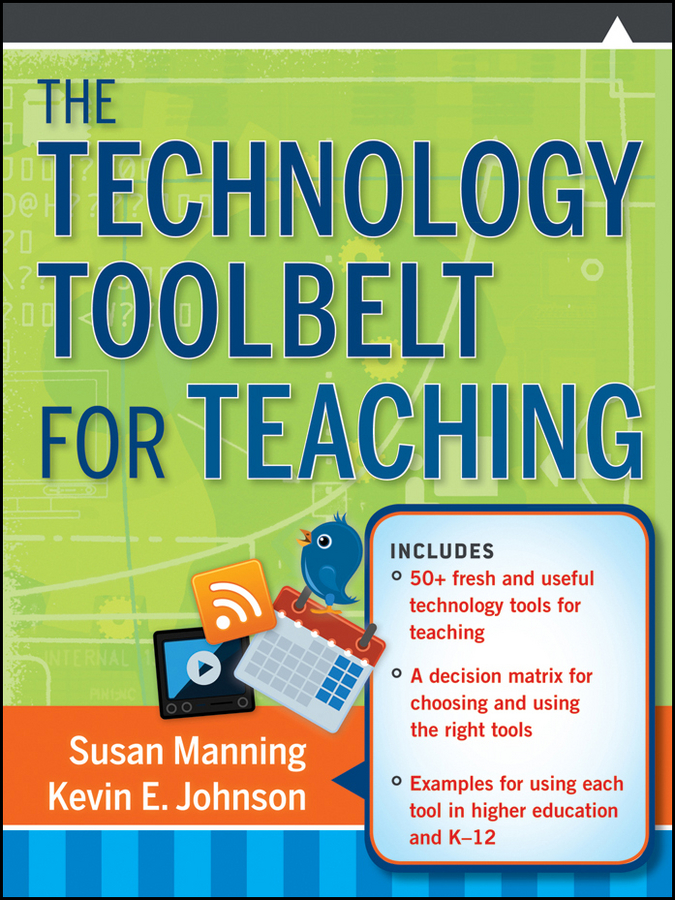
The technology toolbelt for teaching / Susan Manning and Kevin E. Johnson.
Material type: TextSeries: Jossey-Bass higher and adult education seriesPublication details: San Francisco : Jossey-Bass, 2011.Edition: 1st edDescription: xvi, 208 p. : ill. ; 24 cmISBN:
 - 9780470634240 (pbk.)
- 0470634243 (pbk.)
- LB 1028.3 .M36 2011
| Item type | Current library | Call number | Status | Barcode | |
|---|---|---|---|---|---|
 Book
Book
|
Storms Research Center Main Collection | LB 1028.3 .M36 2011 (Browse shelf(Opens below)) | Available | 98643443 |
Browsing Storms Research Center shelves,Shelving location: Main Collection Close shelf browser (Hides shelf browser)
| LB 1028.3 .G724 2013 Google Apps meets Common Core / | LB 1028.3 .H963 2014 Managing the digital classroom : dozens of awesome teacher-tested ideas that help you manage and make the most of every digital tool in your classroom / | LB 1028.3 .H963 2014 Managing the digital classroom : dozens of awesome teacher-tested ideas that help you manage and make the most of every digital tool in your classroom / | LB 1028.3 .M36 2011 The technology toolbelt for teaching / | LB 1028.3 .T3864 2012 Teaching literature in virtual worlds : immersive learning in English studies / | LB 1028.3 .W35 2011 Learning in the cloud : how (and why) to transform schools with digital media / | LB 1028.38 .D53 2005 The systematic design of instruction / |
"Instructors are pressured to integrate technology into their traditional or online instruction. This book offers a hands-on resource that shows how to integrate technology into lessons and offers information about common technologies, categorizing by groups, and explains the purposes they serve pedagogically as well as how they can be most effectively used in online or face-to-face classrooms. In addition to examples, each chapter will feature a decision making matrix to help instructors decide on whether or not a tool is really needed based on curriculum objectives or a specific organizational or curricular problem."-- Provided by publisher.
Includes bibliographical references (p. 199-201) and index.
pt. 1: Introduction. Why Web-based tools? -- How to choose tools and a matrix for doing so -- pt. 2: Tools to help you stay organized. Calendars -- Scheduling tools -- Mind-mapping or graphic organizer tools -- Social bookmarking -- Virtual storage and file management -- pt. 3: Tools to communicate and collaborate. Discussion forums -- Voice Over Internet Protocol -- Instant messaging and chat -- Blogs -- Wikis -- Microblogs -- Web conferencing -- pt. 4: Tools to present content. Audio -- Video -- Screencasting -- Narrated slide shows -- Sharing images -- pt. 5: Tools to help you assess learning. Quizzes, tests, and surveys -- Rubrics and matrixes -- E-portfolios -- pt. 6: Tools to help you transform your identity. Avatars -- Virtual worlds -- Social networking and your students' identities -- Emerging technology.
There are no comments on this title.